

A guide to leading like Jesus at Open Road
"You shall love the Lord your God with all your heart and with all your soul and with all your might." - Deuteronomy 6:5
"You shall not take vengeance or bear a grudge against the sons of your own people, but you shall love your neighbor as yourself: I am the Lord." - Leviticus 19:18
2 If I had the gift of prophecy, and if I understood all of God’s secret plans and possessed all knowledge, and if I had such faith that I could move mountains, but didn’t love others, I would be nothing. 3 If I gave everything I have to the poor and even sacrificed my body, I could boast about it; but if I didn’t love others, I would have gained nothing. - 1 Corinthians 13:2-3 NLT
God is love, and whoever abides in love abides in God, and God abides in him. - 1 John 4:16 ESV
If you keep my commandments, you will abide in my love, just as I have kept my Father's commandments and abide in his love. 11 These things I have spoken to you, that my joy may be in you, and that your joy may be full. - John 15:10-12 ESV
39 You search the Scriptures because you think that in them you have eternal life; and it is they that bear witness about me, 40 yet you refuse to come to me that you may have life. - John 5:39-40 ESV
5 The purpose of my instruction is that all believers would be filled with love that comes from a pure heart, a clear conscience, and genuine faith. - 1 Timothy 1:5 NLT
The Big Picture
If we have not love, we have nothing.
There’s more to life.
We know it. We feel it.
Jesus confirmed it.
Life is for love.
We were designed for it. We desire it.
Jesus lived it.
Jesus’ life of love is God’s vision for your life.
Our vision isn’t for us, it’s for you.
That you would experience everything that God designed you for.
That you would introduce others to that same life of love.
To be and to become, fully alive. Loving God. Loving others as he loves us.
We aim to be the visible, gathered expression of this love for God and others. Our structure is simple and personal because God dwells in us, not our structures. Our focus is teaching each other to lovingly obey Jesus since it’s within this that he guarantees his presence and our joy.
As more people seek Jesus in this way, we need more locations for them to find and follow him personally. To see this vision come to life requires leaders! Leaders who are trained for life, not church; for following, not volunteering. People who are willing to learn about Jesus, lead others to him and continue to teach his life-giving truth for generations to come. This document is your invitation and roadmap to becoming one of those people.
Our Why, What and How
“Go therefore and make disciples of all nations, baptising them in the name of the Father and of the Son and of the Holy Spirit, teaching them to observe all that I have commanded you. And behold, I am with you always, to the end of the age.” (Matthew 28:18-20).
Why are we here?
“I came that they may have life and have it abundantly.” - John 10:10
Our vision for each of us is to be fully alive in Jesus, missing out on nothing of the thriving spiritual life we’re made for.
What are we doing?
“Jesus replied, “Come, follow me…”” - Matthew 4:19
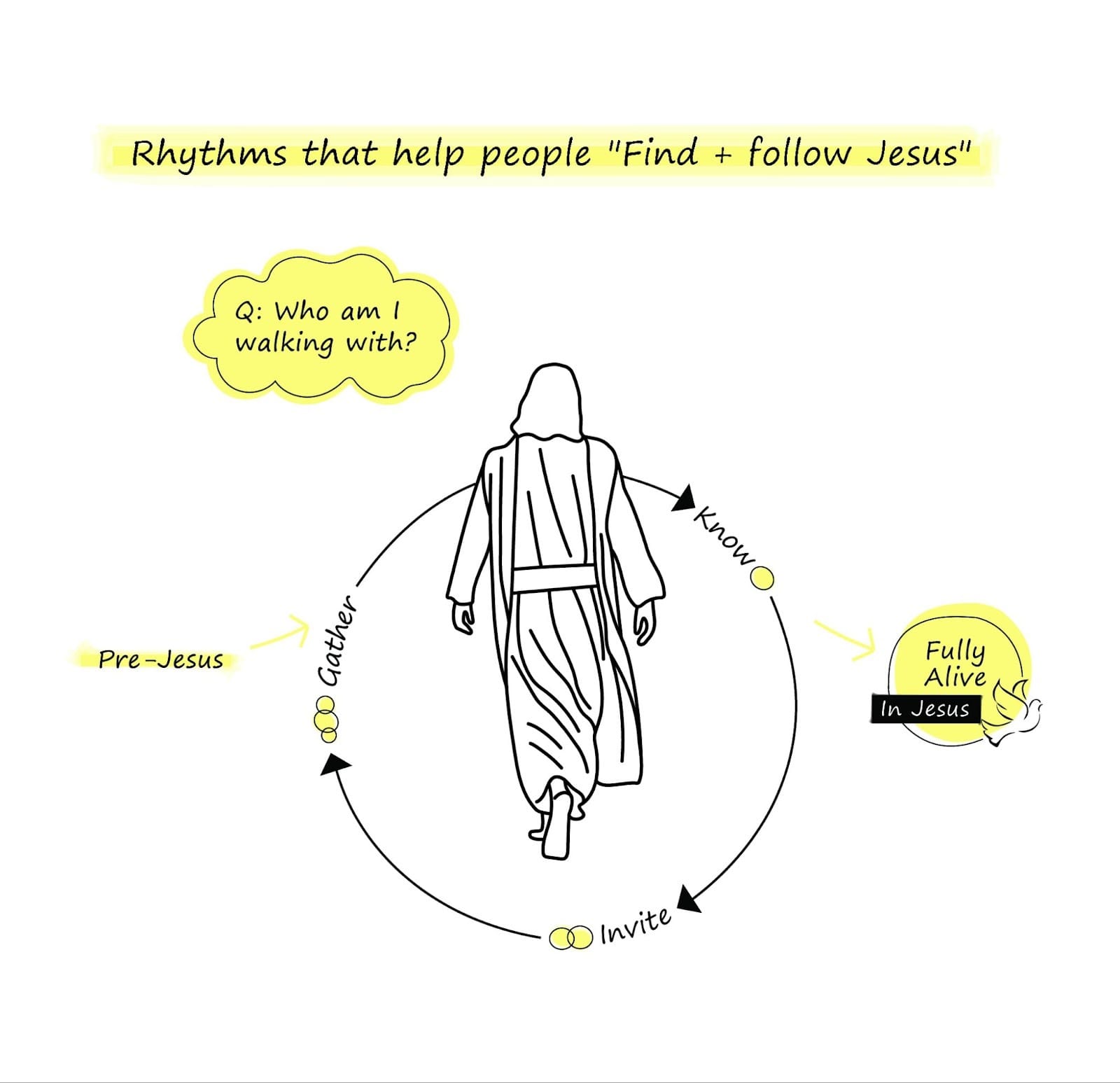
We see this vision coming to life as we help people find + follow Jesus.
How are we doing it?
“Imitate me as I imitate Christ…” - 1 Corinthians 11:1
We intentionally learn, model + champion three rhythms: getting to know Jesus, inviting people into our lives + gathering to encourage each other. While each rhythm can be taught, becoming a disciple is not something that happens to us but someone each of us chooses to become by faith.
Wherever possible, we adopt a life-on-life approach that closely mirrors Jesus’ apprenticeship model for transformative faith + leadership. Jesus said he would only give us light burdens and easy yokes. We foster this light + easy culture in the hope that we ask nothing more of members and leaders than Jesus asks of them. However, his Great Commission in Matthew 28 expands his call for leaders to join him in his mission.
committed
“Therefore, whoever…does them [these commandments] and teaches them will be called great in the kingdom of heaven.” Mat 5:19
Jesus is clear in Matthew 5:19 that Christian leaders must (a) personally follow him and (b) teach others to do the same. The Apostle Paul put this into practice when he taught the first Christians to “Imitate me as I imitate Christ.” (1 Cor 11:1) Christian leadership thus begins with personal spiritual responsibility for our own Christ-likeness and continues with responsibility to help others likewise take personal spiritual responsibility for themselves (Rom 15:1-7). This is a leader’s work!
The Bible identifies Jesus-followers who take responsibility to serve other followers as “deacons” (“Servants”, Acts 6:1-15, 1 Tim 3:8-13). Deacons are accountable to the elders and do the work of the church. In our context and strategy, the work of deacons is bearing operational responsibility for facilitating our three rhythms in the life of our church.
However, Deacons are qualified through their identity as Spirit-filled (Acts 6) Christ-followers, not simply their capacity to lead others or “get the job done." To foster Christ in others, leaders must possess Christ-likeness within themselves.
Our deacons meet at least quarterly to personally encourage each other in our rhythms, ensure we are walking with those who need us and do the work necessary for our church to engage in each rhythm. They continue to communicate and meet as needed to fulfil their responsibilities and ensure they are leading by example.
If you are committed to pursuing and championing a fully alive faith at Open Road, consider joining our team of Deacons.
Below, we provide more details for each rhythm as well as a matrix of
resources and skills we hope to foster in each phase of faith.
Three Simple Rhythms for a Thriving Spiritual Life
If each rhythm is healthy, our spiritual lives will be thriving! However, through the twists and turns of life, if we can maintain at least two out of three rhythms, we will preserve our spiritual well-being.
While we believe participating in a church community is God’s design for us all, each rhythm is intentionally designed for you, personally. Our goal is not to incorporate you into our church organisation, but to help you become a thriving human and member of God’s spiritual family.
We keep the list of skills and disciplines intentionally short and focused on foundational spiritual practices. The skills of following Jesus through suffering, cultivating deep relationships and learning contemplative prayer all foster maturing faith. The key disciplines of fasting, giving and prayer come from Jesus’ “Sermon on the Mount”, and are for each of us.
Finally, the personal assessment questions help ensure each of us is truly growing spiritually and becoming like Jesus, not simply practising religion.
Rhythm #1: Getting to know Jesus.
Matthew 4:19; John 14:15-25; Galatians 5:16; Philippians 3:10
Goal
“Open Hearts”, a thriving spiritual life that fosters intimacy with Jesus.
Long-Term Spiritual Skill
Living with and like Christ in every season, especially through suffering.
Key Spiritual Discipline
Prayer. Matthew 6:5-15
Personal Assessment
How am I becoming like Jesus?
Focus Areas for Deacons
A church full of people learning to think, live and breathe like Jesus.
Think: Pursuing God’s truth via scripture, catechism, books, podcasts, etc.
Live: Loving obedience to Jesus, including spiritual disciplines (e.g., fasting).
Breathe: Filled, led and empowered by God’s Holy Spirit, just like Jesus.
Pathways for people at critical seasons of faith (e.g. faith, baptism).
Potential Barriers to Overcome
Biblical illiteracy limits people’s awareness of God and his truth.
Consumerism makes us unwilling to sacrifice or submit to Christ.
Unhealthy emotional patterns that limit our freedom in Christ.
Misunderstanding or misuse of gifts and teaching on the Holy Spirit.
Rhythm #2: Inviting people into our lives.
Matthew 22:37-39; Psalm 68:6; 1 Timothy 6:18-19
Goal
“Open Lives”, hospitality that transforms strangers into friends.
Key Spiritual Discipline
Giving to those in need. Matthew 6:1-4
Long-Term Spiritual Outcome
Cultivating deep relationships that spiritually nourish all involved.
Personal assessment
How well am I loving those God has already put in my life?
Focus Areas for Deacons
Informally modelling our rhythms via open homes and open lives.
Formally teaching how to live out our rhythms via groups or courses.
Generosity that meets the needs of our “neighbours” + church family.
Equipping people to Jesus’ story and the story of his impact on their lives.
Potential Barriers to Overcome
Cultures that are increasingly anxious and individualistic.
Schedules that are conformed to culture, not Christ.
Dysfunction in our families of origin that does not mirror Christian hospitality.
#3: Gathering to encourage each other.
John 15:10-12; Hebrews 10:24-25; 1 Corinthians 14:26-33;
Goal
“Open Worship”, gatherings that cherish God’s People, Word and Spirit.
Long-Term Spiritual Skill
Practising contemplative and communal prayer (“Come, Holy Spirit”).
Key Spiritual Discipline
Fasting, a spiritual practice that helps us focus on prayer. Matthew 6:16-18
Personal assessment
How am I spiritually encouraging God’s family when we gather?
Focus Areas for Deacons
Overseeing the elements of our weekly gathering.
Overseeing the elements of our monthly gathering.
Overseeing a team that loves to facilitate congregational worship!
Scheduling of our hosts, preachers, bible readers, worship teams, etc
Communicating our vision for Fully Alive gatherings and those attending.
Potential Barriers to Overcome
Unwillingness of people to commit to a local body of believers.
Personal preferences for church and worship that our model excludes.
Limitations that come with our unique environment and limited resources.
Fear of publicly sharing, “a hymn, a lesson, a revelation, a tongue, or an interpretation” (2 Corinthians 12).
Learning, Leading + Teaching the Rhythms
“Leadership development is simply nuanced discipleship.” - Ric Thorpe
People learn the rhythms slowly as they progress through three phases of apprenticeship to Jesus: Learner, Leader + Teacher.
Learners focus on knowing Jesus
Those new to faith need to get to know Jesus personally, learning what it means to walk with him each day. This includes learning to invite others into their life and home, and gathering with other Christians for the encouragement that is essential in the early stages of faith.
Leaders focus on inviting others into their lives
Rhythms are best learnt face-to-face. Leaders invite Learners into their lives, introduce them to Jesus and model spiritual encouragement at gatherings. Rhythms continue to be key for Leaders in developing their private devotional life required to move them from new to mature faith (Move, 2016). In these two ways, the Know, Invite and Gather rhythms are not just our discipleship strategy but also our leadership strategy.
Teachers focus on gatherings that encourage others
Teachers prioritise the rhythms for the same reasons as Leaders, but also to become a living, public example for the whole community to imitate. They lead gatherings that champion these rhythms and provide hyper-focused-on-Jesus teaching that ensures the church is encouraged!
To make progress, ask: “Who am I walking with?”
We grow as disciples of Jesus by learning from those who know him better than we do! By asking, “Who am I walking with?”, Learners find a more mature follower to walk with. To make this happen, Leaders/Teachers must be ready to take spiritual responsibility for walking alongside others. The goal is that each of us is formed by Christ, not the world around us.
FAM, Our Fully Alive Model
To help each of us fulfil our Fully Alive vision, we've developed FAM, a process that invites people to become fully alive followers of Jesus. FAM's goal is to train Christians for life, not just church, for following, not just volunteering. It moves in three phases of apprenticeship to Jesus: Learner, Leader and Teacher. We want everyone to learn, most of us to lead, and some of us to teach.
You're welcome to read more about ur Fully Alive Mode (FAM) as well as a long list of recommended resources if you're keen to grow spiritually or plant a church!
Got questions? Reach Out
Ps Dan Harding // 0402 301 568 / dan@openroad.church